II. INSIDE LUDWIG, 1972
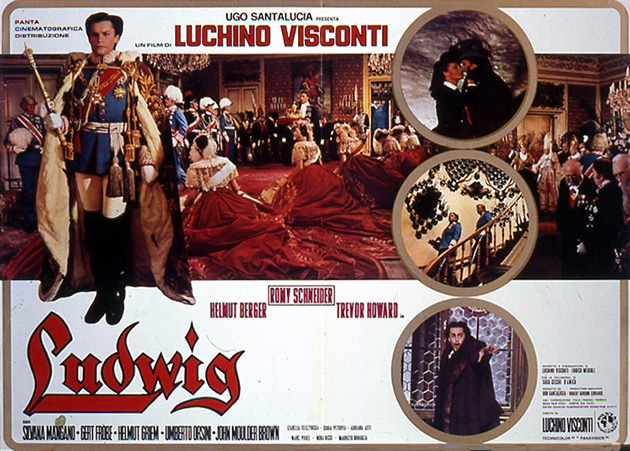
In 1972, La Scala passed from the hands of Antonio Ghiringhelli, who had been at its head since 1948, to Paolo Grassi who, together with Giorgio Strehler, had founded the Piccolo Teatro in 1947. In view of the Ring’s centenary, the decision was taken to prepare a new production of the entire cycle over a span of four years. The director appointed was Luchino Visconti who, between 1954 and 1957, had been behind some of the most landmark productions in the theatre’s history. For some years, the director was engaged for the screen in an investigation into German ideology, which had led him to make his 1969 film The Damned, aptly subtitled as Götterdämmerung, and in 1971 Death in Venice, a very personal adaptation of Thomas Mann’s novel. In 1972, he was working on Ludwig, a monumental film dedicated to the tragic and lonely sovereign of Bavaria, whose story was closely bound up with that of Richard Wagner, played by Trevor Howard in the film. It was, indeed, Ludwig II who enabled the composer to create many of his great works, including the Ring. The character became the focus of interest of younger artists, from Alberto Arbasino to Carmelo Bene and Hans-Jürgen Syberberg, who in the same year realised the film Ludwig. Requiem für einen jungfräulichen König before turning to a series of investigations into Wagner’s world, including the controversial and shocking interview with Winifred Wagner, Siegfried’s wife and mother of Wieland and Wolfgang.
Visconti’s Ludwig is a combination of Wagnerian themes, and not only in the soundtrack, performed by the Santa Cecilia orchestra and conducted by Franco Mannino, the director’s brother-in-law. Filming began on 31 January 1972, principally in the places where Ludwig had lived or had had built, and was completed on 24 June. Back in Rome, Visconti suffered a stroke on 27 July and was transferred for treatment at the cantonal hospital in Zurich, the same hospital in which Thomas Mann died. He was discharged and, despite partial paralysis, he edited the film at the family villa in Cernobbio. The result is a long film for which Visconti was not unfavourable to a two-part showing. At the production stage, drastic cuts were made before the world premiere in Bonn on 18 January 1973. Only in 1980, thanks to the pietas of the director, was a reconstruction of the original made possible, reinstating the “Wagnerian” running time while removing the alteration of the chronological sequence of events envisaged by Visconti, and consequently the magic of the omens.
The music for the film is Wagner’s, from the opening titles when 13 bars of music for piano are heard. These notes were included in the manuscript copy of the score of Parsifal and revealed to Mannino by Arturo Toscanini.
In this room, the sequence being projected is accompanied by music from Tannhäuser and Tristan und Isolde. It follows Elisabeth, the empress of Austria, played by Romy Schneider, and countess Ida Ferenczy, played by Nora Ricci, in a search for Ludwig, the empress’s cousin, played by Helmut Berger. Unable to find him, they pass from one of his castles to another – Herrenchiemsee, Linderhof, Neuschwanstein. On the screen, on the opposite wall, is the image of Elisabeth, lying dead in a room at the Hotel Beaurivage in Geneva, a fragment edited out of the present version of this masterpiece.